Thursday, May 19, 2016

May 19, Thursday


Howdy from Beijing! 

Today was our typical "American Tourist" day in Beijing.  Not having any agriculture related stops, we got the low down on the City of Beijing. 

Rolling out of bed bright and early, we were on the bus by 7am headed to the famous Tiananmen Square and Forbidden City to beat the rush (crazy tourists) that come in the middle of the day.  These historic places in the middle of downtown Beijing are an important part of China's ancient and modern history. 

Sitting on more than 110 acres, Tiananmen Square can host over half a million visitors at a time.  It also houses former Dictator Mao's tomb as well as a Monument to the People's Heroes and the Zhengyangmen Gate.  It is surrounded on either side by the People's Congress of China building and China's National Museum.  It was kind of cool to see who had the most curious Chinese people that would ask to take a picture with the weird tall white people from America.  Being the tallest guy, I think Corey got featured in the most snapshots. 

Crossing the street, we headed into the first gate (Tiananmen Gate) of six gates entering into China's Forbidden City.  This city was home to the royalty of the Quin and Ming Dynasties from 1406 till 1924.  Taking over 300,000 workers to build, it was under construction from 1406-1430 A.D.  It was called the Forbidden City because the common people were never allowed to enter its gates until 1925 when it was opened to the public.  It was home to over 3,000 royalty and concubines at a time, with an astounding 8,704 rooms.  This 180 acre city (in the middle of a Beijing) takes over 50,000 workers to staff.  We were all blown away by the history, detail of architecture, and size of this palace.

During lunch at a local restaurant, our tour guide (Michelle) switched hats for a couple minutes and made a delicious dessert of fried apple toffee, which finally hit a note with the sweet tooth we have as Americans.  I think we've all been missing the sweet desserts that we usually enjoy back home.

After lunch we headed to Yi Xin Tea House where we got the low down on how to make real Chinese tea.  Fun fact - there are over 3,000 different types of tea in China, and they are used for everything from liver and eye health, to morning and night tea and even for curing hangovers.  Needless to say, even with the six types that we got to sample, our taste buds went on a roller coaster ride of bitter to sweet and even tangy.  We all left the gift shop with a handful of different boxes of tea to take home to share. 

Following tea time, we made a quick stop at the Temple of Heaven, which was historically used to present sacrifices including oxen, jade, and silks by the Emperors to "The Heavens" to ensure that the Gods would grant them a good harvest of crops.  We enjoyed doing some bartering on knick-knacks and hats from street vendors and playing Chana's version of hackey-sac with the elderly that gather in the temple park to enjoy their day. 

Following the temple visit, we 'swung' by to catch an acrobatic show in a local theater. From the fie motorcycle riders in the cage to the dancing ladies stacked nine high on one bicycle, I think it's fair to say that we were all flabbergasted by the performances.  Wow! What flexibility and body strength!

Next we rolled on down to the Pearl Market to try our hand at more bartering and dickering on gifts for our family & friends (and mostly ourselves).  Basically, the Pearl Market is like the silk market that we visited yesterday - cheaply made products with name brands slapped on them (like Oakley sunglasses, Bose speakers, Coach purses, or Rolex watches).  The listed price is about what you would pay for the actual name brand products, and your challenge is to dicker the price down to about 1/6 of the price.  We definitely got a chance to work on our bartering skills with the rather stubborn shop owners.  We were told to never feel bad for the price we got goods down to, as they would never sell it to you for a loss.  Needless to say, after spending more than we probably budgeted for, we headed off for a local cuisine specialty for supper -- Peking duck. 

Now, Peking duck is basically China's version of a duck burrito.  The whole duck is filled with soy sauce and cooked until the sauce has penetrated the whole duck.  The inside is moist and the outside is crispy.  It is then masterfully carved, and placed into soft wheat tortilla like wraps with cucumber and onion slices and hoisin sauce.  The finished meal is nothing like the wild waterfowl duck we're used to eating back in the states - you actually enjoy eating it.  Overall, the Peking duck supper is probably one of the top 3 notable meals from the trip so far. 

So, getting our fill of tourism today has us all looking forward to more agriculture visits tomorrow, with John Deere and Artex Farm Solutions on the itinerary. It's crazy to think that we only have two full days left in China! 

Signing off from Beijing.  Yi huier jian (see you later)! 

-Reba and Andy

Wednesday, May 18, 2016

May 18, Wednesday

 Air quality app
 
 CP info
 
 CP layer
 
 CP
 
 Egg packaging
 
 Feed lines
 
Pioneer

May 18, Wednesday


Greetings from China,  

               Today was our full first day in Beijing. Beijing is a very large city with a population of 20 million people in an area that is four times the size of New York. Our first stop for the day was at the DuPont Pioneer Chinese Headquarters located in the Central Business District of Beijing. The lead marketing and sales director, Adrian Gomez, originally from Mexico, discussed with us the operations of Pioneer in China. Erica Wang, the technical agronomist was also present to answer questions.

In China, Pioneer is only allowed to obtain one license for selling seed, that product is corn. Throughout the country approximately 38 million hectares of corn are planted each year. This is the sole reason Pioneer focuses on corn rather than the other crops within their company. The seed is completely produced locally throughout the Chinese provinces. There are 13 research and development locations along with 4 production facilities, these are comparable to what we would see in the United States.

One of the issues Pioneer faces in China is the selling of counterfeit seed. This occurs when people either mislabel seed as a Pioneer brand or steal Pioneer's hybrids and sell it for their own profit. This is controlled by very detailed packaging and labeling such as barcodes and secret codes only to be detected by black light. This is to insure the product is what the farmer is paying for.  

Different from what we are used to in the United States, the amount of seed needed for each farmer is typically smaller. Therefore, the bag sizes only amount to 4,000 kernels per bag. Although Monsanto and Syngenta are large US competitors located in China, the largest competition for Pioneer is the local seed markets. On the other hand, northern China is home to some larger farmers that would be comparable to the United States where as the southern part you will find the smaller farmers. The most popular diseases and pests found in corn are Northern and Southern Corn Leaf Blight along with corn borer. Agronomists in China recommend a spring application of fungicide for larger farmers but it is not economical for smaller farmers to apply.  

Our second stop for the day was with CP Group, a diversified agriculture company from Thailand that is very large in China and 13 other countries. This is the largest laying operation in Asia and the world with a high interest in biosecurity as we were required to enter a disinfectant chamber for 30 seconds before setting foot on the farm. Mr. Yang led the tour through the site that we visited which was their egg laying farm that consisted of 18 laying barns with 167,000 chickens in each barn. With a total capacity of 3 million laying hens on the site they collect around 2.3 million eggs daily. CP Group works with a cooperative leasing 5,000 acres from the local farmers, the poor population, and the disabled for 20 years. This allows for small farmers, the poor, and disabled to obtain a sustainable income to support their families.  

The technology at CP Group is phenomenal. The use of robots to detect temperature in barns as well as the temperature of each hen allows them to have the highest efficiency amongst their laying hens. There is no use of antibiotics and disease is controlled by vaccines, ventilation and the biosecurity measures mentioned above. The breed of chickens at CP Group are Highland Brown and Lumen Brown, these produce brown eggs which are the consumer preference. After 52 weeks of laying the hens are slaughtered and used in soup that is beneficial to pregnant women in the Chinese culture. They are also used as crocodile feed which is located at this site also. The chicken manure is used as organic fertilizer which is applied to the peach farm located on site.

Dr. Gary Stoner, the vice chairman of CP Group also provided some perspective on agriculture relations between the United States and China. He gave us advice about how important critical thinking is. For example, when comparing Chinese and United States numbers in terms of export, production, and yield it is important to take into account the per capita and how it can distort the graph. A large concern in the United States and the world is the decreasing of China's GDP. Dr. Stoner mentioned that we should not be alarmed as this is expected to happen and the overall trend line is still increasing. As far as regulations on GMO importing, Dr. Stoner believes that China will eventually have to accept GMO corn because of the increase in population.  

The day ended with going to the Silk Market. This consists of many different silk products as well as electronics, purses, kids’ toys, and common souvenirs. It was set up like a shopping mall but the fun part was that all prices were negotiable. It was fun hearing who got the best deal and who came home with the most unique items. We were able to obtain some personal items - Sam bought some silk scarves and Scott bartered down the price on some pretty sweet Legos!

May 17 Tuesday


 Fresh poultry
 
 Black chicken
 
 Blood
 
 Burning hair
 
 Meat
 
 Peeps
 
 Pig head
 
 Pork
 
 Scooter
 
Spices


May 17 Tuesday


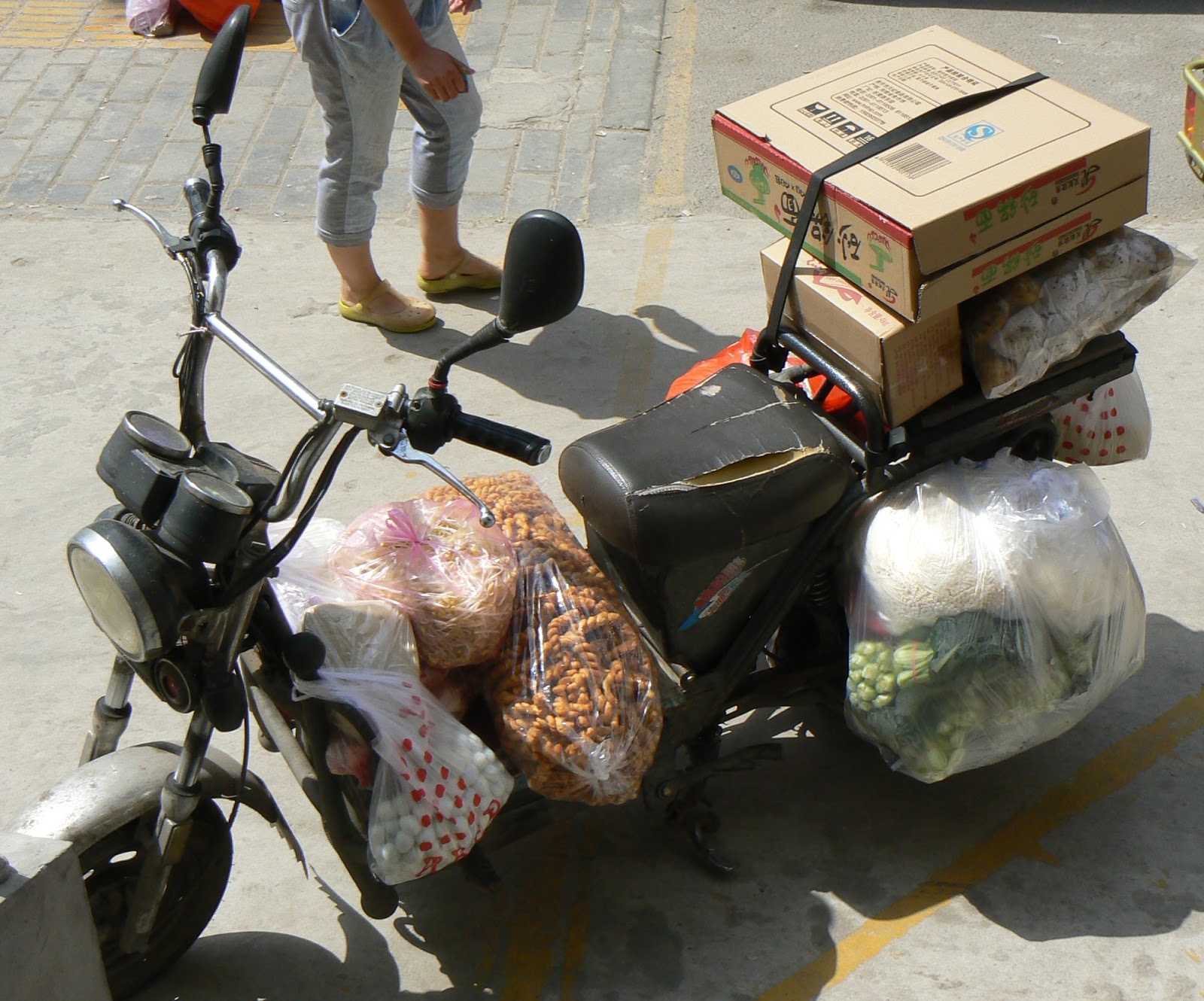
Our first stop Tuesday morning was to a wet market that was a lot newer than the wet market that we visited in Guangzhou. At today's wet market we got to see how different cuts of meat were cut. Some of the carcasses we got to see were pig, goat, chicken, beef, lamb, and fish. While there we had the opportunity to watch a chicken being processed. This was beneficial because we were able to compare how it is done in the U.S. While at the chicken processing booth, we learned why they have black chickens. The people of China created a black chicken with black bones that contains dark meat. The reason the Chinese people prefer this type of chicken is because they believe it is more flavorful. At a different chicken booth we found colored chicks. They were pink, orange, and green in color. The reason they were colorful was due to the Chinese people injecting the embryos with dye. After the wet market we walked upstairs to a spice market. While up there we were able to see and smell the different types of spices the Chinese people use in their meal preparation.  

After we were finished with the spice market we took a one hour bus ride to the train station. Once we arrived at the train station we thanked Maggie for everything she taught and showed us. After saying goodbye to Maggie we went through security and then had lunch on our own in the train station. After lunch we sat in the station waiting until our departure at 1:18pm.  

While on the 4.5 hour train ride we were able to see all the different types of scenery while traveling at 307 km/hr (190 mph). Some of the scenery we saw was local farm fields, as well as smaller villages. Some other scenery we saw was mountains. In America we would normally travel around the mountain but here we traveled through them instead. On the train ride to Beijing it was very interesting to see and compare the land to the United States and how they use it compared to us. The farmers over here would make terrace after terrace to farm every possible inch of ground. Over here all the ground is used for growing crops instead of livestock, whereas in the United States we graze livestock on it and don’t think twice about it.  The ground here is worth so much that the Chinese people can’t afford to do that.

Once we safely arrived in Beijing, we met our new tour guide Michelle. After we left the train station, Michelle took us to a very nice restaurant were we experienced a local hot pot supper. At the hot pot supper we had little individual hot burners with a pot on top of it to cook our various options. Some of our options included mutton, beef, mushrooms, sweet potatoes, noodles, kelp, and shrimp. After supper we took a half hour drive to our hotel to check in to prepare for a full day tomorrow of travel, learning, and sightseeing.

Monday, May 16, 2016

Monday, May 16

 Ms. Gao
 
 Cherry trees and corn
 

 Enjoying dairy
 
 Fierce soldiers
 
 Go Jacks!
 
 Hackey sack
 
Terre Cotta soldiers
 

Monday, May 16


Our first stop on Monday morning was Miss Gao's farm, though the farm is basically still in the city of Xi'an. She farms 4 mu, 2/3 of an acre, of wheat and corn. The wheat is a winter variety that is grown for 10 months and harvested in June. Corn is planted immediately after the wheat harvest and is ready to be hand-picked in September. Miss Gao also has a small cherry-growing business. They reminded us all of Bing cherries from home. Before any cherries can be harvested, the trees must grow for five years. When the trees are young, she attaches a weighted bag to the branches to force them to grow outward so a greater cherry harvest can be sold.  

 Miss Gao plants everything by hand. She uses her experience to judge how far apart the rows and individual plants are from each other. The rows were impressively straight. Even the planting depth is done by Miss Gao's own judgment. To irrigate, she digs shallow canals in between each row and carries buckets of water from their well to fill the canals. They water every fifteen days.  

Because Miss Gao's family works in Xi'an, she does all of this farm work by herself. She hand-pulls all of the weeds and harvests everything by hand as well. The only aspect of her operation she contracts out is the spraying of insecticides.  

Our second stop on the lovely, seventy-four degree Monday was the Terra Cotta Warriors museum. The clay the warriors are made from is called terra cotta clay, hence the name. The clay army is 7,000 strong, though only 2,000 are viewable to visitors. Unknown to most, when the army was first discovered, they were painted with intricate detail, but nearly all unearthed artifacts lost their color from being exposed to sunlight and fresh air. Horses and chariots were also made into pottery along with the warriors.  

 The army was made over 2,000 years ago by order of Emperor Qin of the Qin Dynasty. He was known as a cruel leader, forcing 700,000 people to make the clay warriors. Emperor Qin is buried a few kilometers from his army, who are buried at the base of Lishan Mountain, just outside of Xi'an. The reason for their creation is due to the beliefs of Taoism, which was predominant at the time. Emperor Qin believed the army would accompany and protect him in the afterlife. Each sculpted face is said to represent someone from Qin's real army.  

Our last stop of the day was at Yinqiao Dairy Group, a thirty-eight year old dairy manufacturing company in Xi'an. The president, Mr. Liu, and several other senior executives met with us to show the success of their products and answers any questions we had. Moving forward, Yinqiao Dairy Group wants to increase the diversity of flavors of their milk & yogurt products and make milk a more popular choice of beverage in China. Mr. Liu hopes to continue and expand relationships with the United States, as well as SDSU specifically because of our outstanding College of Ag & Bio. We were also able to tour their production facility, which uses U.S. packaging equipment.  

The evening was open for us to get foot massages, do some shopping, and explore the magnificence of Xi'an. This was definitely one of the favorite days we have had so far. 

Devon Baum & Corey Chicoine